Tuesday, March 21, 2006

electric jam with Pok

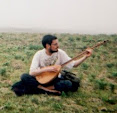
Pok turned up at the weekend with a CD of freshly recorded folk-inspired songs he's written recently. It's a very promising direction he's going in - a couple of the songs in particular ("King" and "Key to the Gate") impressed me more than anything I've heard from him since the original Spacegoats days.

Pok playing my old Westone electricPok's 'address book'
Pok playing my old Westone electric, his palmipsestuous "address book"

On Saturday afternoon we went over to Henry's for a fairly wild electric session:

Henry - percussion
Richard - electric bass guitar
Pok - electric guitar
me - saz

I think this is the first time I've jammed with him playing electric guitar. It's actually a guitar I bought from an art student in Canterbury about sixteen years ago, and which hasn't been played for years. With Henry and Richard as solid rhythm section he was able to completely let go and play his heart out, with me adding my saz input as appropriate. Great fun, if nothing else.

Listen Here

Michael Rose and the Ras-Ites

Last Friday night, as part of the Vibraphonic Festival, I saw Michael Rose (who used to be one of the voices of Black Uhuru) at The Phoenix, backed up by the mighty Ras-Ites. They played their own full length set first, complete with encores. Extremely professional in every detail, but not without heart. There were a few classic covers - they started off with the Nyabinghi chant "New Name, Precious Name", a kind of Rasta prayer to kick things off, and did an excellent version of the Natural-Ites' "Picture on the Wall" - but some of their own material bordered on the slightly cheesy commercial side of reggae (for my taste). Couldn't fault their musicianship though - incredibly versatile, like a lesson in post-ska Jamaican musical history. They did some dubby "steppers" style material towards the end of the set that was magnificent and powerful.

After a break the Ras-Ites came back as Michael Rose's band. He's still got a beautiful voice, and his solo material isn't bad at all (the lyrical content is a bit "Rasta-by-numbers", but he's hardly alone in receiving that criticism). The Uhuru numbers that were played lifted the crowd noticeably. There's was a bit too much of the "Do you want more?" business (when it was obvious that the incredibly apprectiative audience did want more), and the unnecessary shades felt a bit like a "mask of cool", but I shouldn't be too critical. He and the band worked perfectly together (unlike the Roots Radics backing Israel Vibration, or The Robotiks backing Augustus Pablo, neither of which worked half as well) - they were interacting with great sensitivity to the extent that it felt like we were witnessing some kind of shamanic ceremony at certain moments. Exeter's needed a decent live reggae event like this for a while, and it definitely liked what it got.

DJ DerekThe Ras-ItesMichael Rose
DJ Derek, the Ras-Ites, Michael Rose

The evening started out with the legendary (and utterly unique) DJ Derek from St. Pauls, Bristol. He's a sixty year old white bloke in a cardigan, apparently a former accountant who definitely knows his reggae and knows how to rock a party. He's from the Jah Shaka "one record at a time" school of DJ'ing - no fancy mixing, just a solid selection.

Friday, March 17, 2006

trio rehearsal breakthrough

Henry, Keith and I had our fourth rehearsal as an experimental trio last night. Wow. I'm suddenly very happy with the way it's going.

The pieces really seemed to come alive in ways they hadn't before. The previous rehearsals left me somewhat unsatisfied, feeling like wandering in a fog or doing homework. This time it was sheer joy. We're relaxing into it, and finding ways of "working stuff out" without all the usual "arrangement" formalities - we're just playing with ideas, getting to know certain riffs, themes, tunes, melodies, rhythms...The five-rhythm piece was incredible to play. Henry and Keith were both very confident with that, and I was to fly off and try stuff I'd never attempted in five - I completely lost my way several times, but the groove was still there to climb back up into. Wonderful.

I introduced a couple of new ones - "Offa's Dyke" (one of my simple creations) and a Northumbrian ballad called "Bonny at Morn".

I may even post up some audio from this one in due course.

Thursday, March 16, 2006

Experimental Audio Research

I saw Pete "Sonic Boom" Kember's most recent project, Experimental Audio Research last night, down at The Cavern, supported by Knowledge of Bugs. Lots of circuit-bending analogue weirdness and throbbing electronic drones.

Knowledge of Bugs is one person in a labcoat and geeky glasses, seated before a table of home-made gadgetry, who comically bumbles his way through his set and sings quirky songs with an echoey electric guitar in an endearing Durutti Column kind of way. He came down to The Phoenix to do a circuit-bending workshop last weekend, which Simon Drone attended and enjoyed thoroughly. That last Drone session at Henry's house even involved some sounds generated by the device that Simon put together at that workshop.

E.A.R. - image from http://www.kickbrightzine.com/shows/ear.html
E.A.R. in Florida - image from http://www.kickbrightzine.com/shows/ear.html

Kember played a single piece - a bit less than an hour, I think, although one tends to lose track of time in that kind of psycho-sonic envirnonment. He had his back to the audience throughout, as he manipulated his vast array of (mostly) analogue electronic gear (including an old Texas Instruments "Speak and Spell" toy and a huge patch board covered in multicoloured electromagnetic spaghetti). I'm not sure if this is shyness, arrogance, indifference, or what, but basically it meant that we watched his back for the whole performance. It wasn't even clear when he'd started. There were still records playing, and he was just kind of there, fiddling with his gear. Then it got noticeably louder fairly quickly, and everyone flocked in to stand and face his back. For some reason he sets his equipment up on fairly low tables so he's stooping the whole time, which left me feeling uncomfortable, thinking about possible back problems this might cause - watch your posture, Pete!

I was well into his band Spacemen 3 back in the late 80's when I was a student - saw them a few times including a killer set at the '89 Reading Festival. I even jointly interviewed him on UKC student radio when they came to play there. I'd rather lost track of his work during the last 15 years, but it seems he's lost interest in guitars, having discovered that he can get the sounds he wants without conventional instruments. The result is something like Spacemen 3 without any vocals, melodies or rhythms. Or like Hawkwind without any vocals, melodies or rhythms. Or like...But I did get thoroughly into what he was doing (with hastily constructed toilet paper earplugs to defend myself from the more intense high frequencies).

He left as unceremoniously as he arrived - brought the sound down to a minimal burble, stopped it, turned around to glance at his audience for about half a second, waved/saluted "good night" and walked straight off stage. There was something uncanny about the way we only got to see his face for a fraction of a second - I sensed a real intensity there which would be entirely in keeping with the nature of the music he'd just made.

Wednesday, March 15, 2006

maximal Drone session, Prospect Park

Yesterday lunchtime Vicky and I went to see a performance of the Exeter University Singers in the University Chapel. I was pleasantly surprised how good they were - singing various works of Purcell, Warlock, Dvorák, Elgar, etc. Their organist was stuck in traffic, so the conductor (a second year student, incredibly professional) managed to conduct some of the pieces while standing up playing a piano sideways. I'm no connoisseur, but the singing sounded properly celestial to me throughout.

The design of the Chapel ceiling
The design of the Chapel ceiling, by Sir Thomas Monnington (1902-76)

Then, in the evening, a rare Tuesday COTD session - a full moon, Purim, and Maceo Parker (James Brown's old sax player) playing in town that night.

The biggest Drone population in a while...Vaughan was able to make it for the first time in ages - always nice - and we had an excellent new pianist/percussionist droning with us for the first time. We probably weren't quite as funky as Maceo and his band, but a great, floaty-yet-percussive session nonetheless...

We ended up occupying two adjacent rooms which meant that Simon's laptop weirdness didn't come out as loudly as it should have. It was hard to decide where to place the microphone - in the end I hung it from the mouth of a raku-style ceramic fish (hung above the door between the rooms), one of Henry's wife Lucy's many raku creations.

raku fish by Lucy Rockcliffe

Richard - electric bass guitar, percussion
Henry - percussion
Vaughan - acoustic guitar, mandolin, percussion, nose-flute, voice
John - sitar, acoustic guitar, bouzouki, mandola, percussion, voice
Keith - electric guitar, percussion
Simon- laptop, electronics, mini-keyboard, detuned balalaika
Brian - piano, percussion
me - saz, balalaika, percussion
Listen Here

Monday, March 13, 2006

last.fm

I've finally got a last.fm account together. This is the web-service that customises audio streams to your music-taste profile, and uses relational databasing and social networking mechanisms to allow audiences to find artists they might like and artists to find audiences that might like them.

I've created a kind of virtual Children of the Drone label for last.fm. That's based here - I've uploaded all our compilations as "albums" (with the individual MP3 files all properly tagged, etc.). One of them has gone live, the others should be through soon.

The last.fm player
the last.fm player

We've already got a few 'fans' as a result of some IAA material somehow leaking into peoples' accounts. Oddly, the top three names which come up - "tr00 viking", "nucleardent" and "S-Bloodstains" - appear to be primarily death-metal and grindcore enthusiasts! Perhaps this is the target audience we've somehow overlooked!

"nucleardent" has even written an enthusiastic piece about us in his last.fm "journal". We were top of "tr00 Viking"'s personal chart with a piece called "untitled" - but that now appears to be the result of him listening to numerous pieces which have all been mistakenly identified as a single track.

Sunday, March 12, 2006

The Lady Chapel, Glastonbury Abbey, spring 2003

I've just been compiling a CD of music I've recorded with various people at various sacred sites around Britain, particularly along the "Michael-Mary line". This is going to be a gift for Phil Lesh, whose recent autobiography has reminded me of his interest in the geomancy of the British Isles, sacred geometry (according to David Dodd's book he even met author John Michell when over here in '72). If it actually makes it into his hands, I expect he'll be pleasantly amused to know that there are people again gathering at these sites and making cosmic/ecstatic music in a spirit he will be familiar with.

In the process, I realise how little material I have recorded at Glastonbury - nothing from the Tor (depite having played up there a lot over the years). Usually it just seems inappropriate to set up recording gear (or the ever-present wind makes it somewhat pointless). I did find one thing, recorded in the Lady Chapel of the Abbey ruins back in March 2003. I can remember this time clearly, as the invasion of Iraq seemed to be unstoppable, despite the massive protests going on. I got a bus up to Glastonbury to connect with Stef, remember him and Tom meeting me at the bus stop by the memorial cross at the bottom of the High Street, Tom playing his funny-shaped African drum. Later that day we ended up joining forces with David (formerly of the Vienna Boys' Choir, now an Avalonian hippie musician) and the faerie poet Kelfin, who I knew from Dublin when he was just Kevin. This led to a spontaneous session at the Abbey - not musically brilliant - the drumming's just a bit too overbearing, but Stef makes up for it in places with some punchy concertina playing. I'm hammering away at my saz throughout.

Lady Chapel, Glastonbury Abbey

I might just extract a couple of minutes of this for the CD, for completeness' sake. I have some nice stuff from various locations in Cornwall, as well as Avebury and some Dronings from Crediton.

Stef - concertina, mandolin
me - saz
Banana Tom - percussion
Kelfin - percussion
David - voice, recorder, percussion

Banana Tom's drumming is somewhat overpowering, but he was very much in the spirit of the moment. Some punchy concertina playing from Stef largely redeems these spontaneous recordings. David at one point sings the ancient fertility song "Pat-a-Pan".

Listen Here

Abbey ruins in Avalonian mist geometric plan of the Lady Chapel
Abbey ruins in Avalonian mist, geometric plan of the Lady Chapel

The geometry of the Abbey, particularly the Lady Chapel is fascinating, and has been explored by writers such as John Michell. This chapel is the supposed site of the first Christian Church built in the British Isles, built, according to legend, by Joseph of Arimathea. Here is an introductory website.

Friday, March 10, 2006

Polar Bear at the Phoenix

I saw Seb Rochford's amazing Polar Bear at The Phoenix Arts Centre last night. We were meant to be having a Drone session, but gradually more and more of us pulled out, not wanting to miss this gig. It turned into a bit of a COTD musical field trip - James T, Melski, Keith, Philip, Vaughan and I (and I believe Mark was there). There was some vague talk of having a guerilla session in one of the gallery spaces beforehand, but a new exhibition was opening, and we're not foolish enough to attempt to play wholly improvised music in the noisy, crowded Phoenix bar anymore. I was almost put off by all the hype, but I'm so glad I went! I'd listened to a few MP3 soundclips off various websites, but there's no way you can get any sense of the expansiveness of this ensemble from a few 30 second excerpts. Henry chose not to come on the basis of these soundclips, and I suspect that he would have loved thier set .

Everyone should see this band! Leafcutter John on electronics - triggering the maddest barrage of sound from his iBook laptop via a Playstation controller (and really getting into it!) - brought to mind more than anything the staggeringly boundaryless creativity of Mike Ratledge's organ playing which I'd been dwelling on after seeing a sort of Soft Machine lineup less than a week ago...except rather than an organ, he had at his disposal what sounded like a gamelan orchestra, disembodied grand piano and contents of a well-equipped kitchen inside a giant pinball machine being played by King Tubby in a virtual universe whose laws of physics were jointly programmed by the composers of the zaniest 1950's cartoon soundtracks and the creators of 1980's arcade games.

Now that 'Soft Machine' line-up with Leafcutter John would really be something...

Leafcutter John with Polar BearSeb Rochford of Polar Bear
Leafcutter John and Seb Rochford of Polar Bear

LJ also turns out (despite looking extremely youthful) to have a lectureship in electronic music at the University of Aarhus in Denmark.

During the first piece I just thought he was a superfluous 'electronics' person to give the ensemble a sense of being 'relevant' - he wasn't particularly audible. Then, when his sonic attack began, I couldn't see quite what he was doing from my vantage point, but he appeared to be making sounds though physical motion, so I thought it was perhaps a kind of theremin-like object (or something like Mikey Hart's infamous "Beam"). It was only much later that I realised that it was a Playstation controller, and that his motion was not directly causing the music (although it was clearly linked to it!). I've never come across anyone using live electronics so effectively - actually playing it rather than just playing with something effectively pre-recorded or pre-sequenced. The sensitivity and control was just awesome - he would lock into one the two sax players, the bass player (all excellent, by the way) or Seb and sort of 'duel' with them, seemingly sampling and looping them, and playing deformed looped versions of themselves back at them, creating weird psycho-musical feedback loops. At one point he was twanging odd notes on a mandolin into a microphone, creating disjointed off- kilter rhythms by layering and looping this - Seb would just pick these rhythms up with total ease and run with them.

The actual 'jazz' compenent reminded me a bit of the Lounge Lizards, but wilder and more multi-dimensional. There were elements of prog, psychedelia, punk/hardcore, musique concrète and just plain uncategorisable sound going on.

Wednesday, March 08, 2006

Matthias Loibner

My hurdy-gurdy-playing friend Joel has alerted me to the homepage of Matthias Loibner, an Austrian experimental gurdy-maestro who I saw play once at the Saint Chartier festival in 1999. I was just browsing amongst the vast array of instrument makers' stalls, and happened to stop to look at a selection of ultra-high-tech hurdy-gurdies, made by a German or Austrian luthier (very sleek and angular with aluminium panels and multiple on-board preamps, etc.). An unassuming young man with glasses was about to demonstrate one of them. He plugged in, starting Z'ing, and suddenly hurtled into a Hendrix-ian gurdy vortex, kind of "strumming" the whole instrument to produce sounds that were just jaw-dropping. I can't think of another occasion when a single, unaccompanied musician has blown me away to quite that extent.

Matthias Loibner on a beach in ItalyMatthias Loibner
Matthias Loibner on an Italian beach one November, and lost in an orange gurdy-world

Here is a page of MP3 downloads he's provided. If you're not familiar with the instrument, it might be better not to start with the first piece - he plays that one without using any of what Joel calls "Z's", so it ends up sounding like a virtuosic violin solo with an odd clattering sound (the wooden keys) in the background.

And here's some rather less refined saz and gurdy stuff Joel and I recorded late one night a couple of years ago.

Soft Machine "legacy"

I saw a Soft Machine line-up of sorts play last Friday night at the Phoenix Arts Centre. This is a grouping which has been touring as "Soft Machine Legacy" (for legal reasons?) but who FSOE put on as part of the Vibraphonic Festival as simply "Soft Machine". Hugh Hopper is the only member from the early Soft Machine period of which I'm most fond, but his bass playing alone was worth going along to check out – the rest of the ensemble consisted of later-period Soft Machinists John Etheridge (guitar), John Marshall (drums) and Theo Travis (flute and saxes) who was filling in at the last minute for Elton Dean who sadly died about a month ago.

I'd spent most of the previous 24 hours listening to some astonishing 1968 (Kevin Ayers period) bootlegs - from Amsterdam and Iowa, of all places, also an Oslo 1970 tape featuring Wyatt, Hopper and Ratledge, and the first three Soft Machine albums, so in a way I was setting myself up for disappointment – how could it be remotely satisfying without Ratledge's insanely brilliant organ playing?

Wyatt, Hopper, Ratledge - probably 1969
The Soft Machine: Wyatt, Hopper, Ratledge - probably 1969

But I wasn't at all disappointed. They were excellent, for what they were - a talented, inventive jazz-rock ensemble, striking the right balance between looseness and precision. They ended set with something familiar off the mighty Third album (I can never keep track of the names of those pieces) – everything else from the later jazz-rock repertoire with which I'm only vaguely familiar. The encore was a piece of free improvisation ("We've played all the tunes we know," Etheridge explained), quite impressive too. Theo Travis did a fine job, standing in at the last minute like that, and I discovered what an astonishing drummer John Marshall is. Hopper was joy to watch and listen to. All in all they did the Soft Machine name proud. The Canterbury vibe came through, despite the noticeable lack of kaftans, beards or freaky dancing in the predictably un-ecstatic audience.

Hugh Hopper more recently

At the same time I'd been listening to the wilder, early Soft Machine material I'd been reading Phil Lesh's account of the heyday of the San Francisco psychedelic ballroom scene, as well as an article from the most recent edition of The Wire about Quicksilver Messenger Service. This led me to (particularly during the singularly dull support band - a jazz fusion unit made up of excellent musicians, but entirely lacking vibe) spend a lot of the event wondering where the wildness has gone. The audience mostly just stood there in neat rows, politely clapping after individual solos. I can remember my friend Tim (in Whitstable, just a stonesthrow from Hopper's residence) playing me a bootleg of early Softs, from somewhere on the continent, where the youthful audience were so enlivened by the wildness of the sound that they started rioting! Similar scenes happened when Stravinsky's Rite of Spring was debuted, also Rock Around the Clock, the first major rock 'n' roll film, first hit the cinemas. This astonishing tape contained the incongruously posh voice of an outraged Mike Ratledge who stopped playing to chastise the audience rather like an old-school English headmaster!

So where has the wildness gone? Obviously the significantly increased average-age of the Soft Machine audience and relative lack of drug-intake has something to do with it, but I can't help thinking it's more a matter of the zeitgeist. What kind of music could provoke this kind of reaction in 2006? Is that kind of intensity-of-reaction even possible any more, I wonder?

Monday, March 06, 2006

Espers!

Philip from the Droners has just alerted me to the existence of the most wonderful American 'psych-folk' band - Espers, from Philadelphia.

This radio programme is the perfect introduction - it's from a Public Radio station in NYC, and features in-studio performances, an interview with all six members, and the band selecting some of their favourite records (obscure acid folk gems, mostly). They're clearly Incredible String Band fans, something one doesn't encounter a lot in the States (although I met one after playing a solo saz set in a coffeehouse in Wisconsin when I was recently over there).

Espers, playing recently at Fels Planetarium, Philadelphia

Twelve minutes into the programme and I was already won over (they play a beautiful, gentle version of the traditional song "Black is the Colour").

It seems they're playing at the All Tomorrow's Parties Festival in Sussex in May (with Bert Jansch, Vashti Bunyan, and others). I think I'm going to have to go...

Phil Lesh - Searching for the Sound

I just finished Phil Lesh's excellent autobiography Searching for the Sound: My Life with the Grateful Dead this weekend. It's highly recommended for anyone who's even vaguely curious about what the GD experience was all about. I read Tom Wolfe's The Electric Kool-Aid Acid Test years ago, and this provides another angle (from the inside) on the heyday of the San Francisco psychedelic ballroom scene, but also follows through the legacy of these events into the mid 90's (the tragic death of Jerry Garcia in '95 being the pivotal event) and beyond.

It was most interesting to read about the influence of both John Coltrane and Charles Ives on the evolution of the early Dead (via Phil):

On p.27 he describes seeing the Coltrane Quartet in the early 60's:

p.27 "Just after I returned from [the] Ojai [Festival (where his teacher Luciano Berio was composer in residence)], I was fortunate enough to hear a legendary performance by John Coltrane's new quartet at the Jazz Workshop in San Francisco. That night, the great guitarist Wes Montgomery, who had made his early reputation in the San Francisco scene, joined the band onstage. I stayed for both sets, and to this day I haven't heard a performance in any genre of music that came close to reaching the heights of that one. The band played pretty much continuously, with very few breaks, starting at a peak and climbing: The atmosphere of that funky little club literally turned golden...That night confirmed, in spades, my earlier suspicions that improvised music could reach the heights and depths of the finest classical music, and transcend time and space."

The Haight-Ashbury district in early 1965:

"The Haight at that time was just beginning to see the influx of hipsters and tripsters that would later culminate in the notorious Summer of Love – but at that time..., it was just a pleasant neighborhood in which to live...On any brisk spring evening we could wander through the residential areas listening to the wonderful variety of music drifting down to the street from open apartment windows; in the course of a single block, one might hear Bob Dylan, Joan Baez, the Beatles, John Coltrane (and on one memorable occasion, Bach's monumental Mass in B Minor), all blending in a most delightful polyphony of musics. Looking back, it seems as though this experience was a metaphor for the community as yet unborn, the "mingled measure" of which Coleridge speaks so eloquently in his poem "Kubla Khan," promising a rebirth, through music, of spirit and shared awareness of our common humanity."

Phil in the psychedelic heyday - image from photobucket.comPhil more recently
Phil in the psychedelic heyday, and more recently

Describing the earliest rehearsals (when the band were still called The Warlocks):

"...it was the most exciting musical challenge I'd ever faced, including composing for orchestras – I had to play new ideas without thinking, based solely upon context and expressive intent, and there was no space for reflection or revision. Except, of course, when I made a mistake: After playing a wrong note, for instance, I would quickly resolve it to a proper note – but then I took to repeating my mistakes (a simple matter, since the music was built out of repeating modules, or strophes) in order to resolve them differently each time. I soon began to see the dissonances caused by wrong notes, or right notes in the wrong place, as opportunities rather than liabilities – new ways to create tension and release, the lifeblood of music. This approach was to bear strange and wonderful fruit over the next five years of the band's development."

"We had started out by expanding tunes through extended solos, mainly to make them last longer since there were so few of them. However, the longer the solo, the less interesting it became to play the same material as background, so those of us who weren't soloing began to vary and differentiate our "background" material, almost as if we were also soloists, in a manner similar to jazz musicians. A good example of this technique is our version of the old Noah Lewis jug band tune "Viola Lee Blues," a traditional prison song. We electrified the song with a boogaloo beat and an intro lick borrowed from R & B artist Lee Dorsey's "Get Out of My Life Woman," and after each of the three verses, we tried to take the music out further – first expanding on the groove, then on the tonality, and then both, finally pulling out all the stops in a giant accelerando, culminating in a whirlwind of dissonance that, out of nowhere, would slam back into the original groove for a repetition of the final verse. It was after a run-through of this song that I turned to Jerry and remarked ingenuously, "Man – this could be art!

In pursuit of this idea, I urged the other band members to listen closely to the music of John Coltrane, especially his classic quartet, in which the band would take fairly simple structures (the show tune "My Favorite Things," for example) and extend them far beyond their original length with fantastical variations, frequently based on only one chord.
"

The cosmic possibilities of modal jamming are enthused about later in the book when describing the band coming out of "Midnight Hour" at the "Trips Festival" Acid Test at the Longshoreman's Hall (1966?)

"...and we go off on those two chords as if they are Jacob's ladder, with souls rising up on one side and drifting down on the other. We are showing serious respect to the power of these relationships: D-G-D-G-D-G. Hang on! The only pattern better for playing than two chords is one chord! So away we charge to wring the neck of some poor hapless tonic (D, in this case) and ravage all its sniveling overtones until the air screams for mercy – it feels so good, why should we stop, or even slow up? But wait! The skies are opening! The Old Ones are returning! No, we've merely reached the eye of the storm, and suddenly the music broadens out into an almost hymnlike character; we're back to the two chords now, rich and glowing as they march endlessly into infinity, mirroring the waves of dancers. The form moves on, the particles remain."

There's a description of Phil spontaneously convincing the entire band (including Pigpen!) to come to a performance of Charles Ives' Fourth Symphony at Carnegie Hall while they were in New York City in 1967:

"The sense of space (height, width, and depth) is palpable: the music reaches out to embrace us; withdraws into the distance; then, like a steam locomotive, comes suddenly roaring back. Invisible bands march across the soundstage in two different directions at different speeds; a solo viola mutters an occult hymn-tune as the rest of the orchestra sprays fireworks in all directions; the chorus in all directions; the chorus intones wordless transcendental benedictions as the music fades away into silence. We all were blown completely away. None of us could even speak for the longest time. Mickey [Hart] was so amazed ("Holographic! Life-transforming!") at the cross-rhythmic marching bands, he had to hear it again, so he and I went back for the second night. The fact that that particular passage required three conductors made it even more fascinating. Right there and then, Mick and I began trying to figure a way to do something similar with our music."

It was also enlightening to read about the introduction of polyrhythmic experimentation (which is also described from Mickey Hart's perspective in one of his books).

"At this point we began working with exotic time signatures: seven, ten, eleven beats to a bar. In some instances, we could take phrases that were in normal meters, such as four or three, and simply extend one segment, arriving at irregular pulses in that way. In other instances, we could be working out a pattern in, say, eight beats, and some one would mistakenly play it a beat, or half-beat, shorter or longer: "Hold it! Do that again!" "What?" "What you just did!" "What? You mean this?" "No! You know [hands waving descriptively]...the other thing!" "Oh! This?" "Yeah! Let's all try that!" Our improvisational philosophies such as "There are no mistakes, only opportunities" and "The one [downbeat] is always where it seems to be" began with this type of discovery.

...I was so excited by these developments that I instantly wanted to take it further: Let's play in and out of these meters and weave them into the flow of the improv (for example, when half the band plays twelve bars of eleven and the other half plays eleven bars of twelve, all with accents), instead of just playing riffs that we work out on and then move on to some other box. "Why, we can shift rhythmic gears seamlessly if we play on the pulse! Let's try it. Five, six, seven..."
"

Backstage at the Fillmore West in late spring '69, Phil describes being spiked with a very strong dose of LSD (even by the standards of that scene) shortly before the band were about to play:

"I was launched into outer space: worlds and universes orbiting past, time stretching into eternity, laughing archetypes manifesting cosmic jokes, and then some soft words in my ear - "Phil, it's time to play the set."

What? What set? Mickey was standing next to me with a most compassionate expression, saying, "Phil, come on, we gotta play now." Never had I imagined that I would find myself in a state of being where playing music would be a bring-down – but there I jolly well was. "Mick," sez I, "I wish you could be where I am right now – it's so beautiful; but I couldn't possibly play music now. I don't even know what music is." And I drifted away, back to the glory unfolding inside.

After aeons of time seemed to have passed, I became aware that I was on some level, still in a room full of people; one of them, whom I recognized as "Mickey," was holding an obscure, elongated device with knobs on both ends and iridescent silver scaly strands holding it together. "Phil," he said, "this is your bass. You play this instrument in our band." Oh, yes, I remember now. How does it work? "Just put the strap over your head like this" - and Mickey took me by the hand and led me to some stairs and then up onto the stage. To this day, I don't really know whether or not Mick was as high as I was, but this tenderness and compassion toward me that night have never left me, and I've never loved him more than at that moment.

Once on stage, everything seemed somewhat more familiar, even though the instruments and amplifiers (not to mention the other musicians) were grinning at me with alien features superimposed on their own. Somehow, I don't know how, we managed to start playing: It was as if the music was being sung by gigantic dragons on the timescale of plate tectonics; each note seemed to take days to develop, every overtone sang its own song, each drumbeat generated a new heaven and a new earth. We were seeing and singing the quantum collapse of probability into actuality – it was frightening and exhilarating at the same time. At one point, I looked over at Jerry and saw a bridge of light like a rainbow of a thousand colors streaming between us; and flowing back and forth across that bridge: three-dimensional musical notes – some swirling like the planet Jupiter rotating at 100 times normal speed, some like fuzzy little tennis balls with dozens of legs and feet (each foot wearing a different sock!), some striped like zebras, some like pool balls, some even rectangular or hexagonal, all brilliantly colored and evolving as they flowed, not only the notes that were being played, bu tall the possible notes that could have been played. That moment may well have been the peak of psychedelic music for me – the combination of absolute inevitability and ecstatic freedom has never been equaled.
"

On a reconnaissance mission to Egypt he and some of the GD crew made in order to plan their 1978 concerts at the Great Pyramid of Giza the obligatory visit was made to the King's Chamber...

"We've read of the remarkable acoustic properties of the Chamber, so we begin to hum and chant, and sure enough, the sound resonates so fully in this small space that a much vaster space slowly opens in our minds. We close our eyes; we might well be in an underground cavern, or a great cathedral. Our voices find the resonant tone of the Chamber: The sound expands into infinity, and we begin to hear strange, occult harmonies resounding above our fundamental chant-drone. The energy is so strong that the sound grows louder and more complex without any of us doing anything – the feedback system works perfectly. The sound orders itself into celestial music, with so many layers one can't possibly comprehend it all. I'm straining to hear more deeply when our guide abruptly enters – and the magic is gone, the thread snapped."

and a few days later, on the Nile...

"This, then, was the real Egypt; pharaohs, kings, prophets, and presidents may come and go, but the Nile, in an ageless rhythm, continues to provide sustenance for its people. At sunset, as if in affirmation, the people on the neighboring boat broke out some instruments and began jamming! A flute or oboelike wind instrument, two small hand drums, and voices punctuated with clapping hands – human beings making music for the sheer joy of it: No doubt revisiting old favorite songs (and adding bawdy lyrics), they played far into the night with an exuberance and élan that took our breath away. It's a happy thought: Even if there were a culture in which there were no professional musicians, everyone would make music as well as they could anyway, without thinking of personal recompense, because music is ambrosia for the soul."

All the 70's drug-addiction and interpersonal issues are covered quite directly without any attempt to gloss over the ugliness – quite painful to read - but the focus is always on the music, as one might expect from Phil Lesh. It's quite amazing how much celestial music was produced in the last two decades considering the state many of the band members (and their relationships with each other) were in.

I recently checked out his post-Dead band "Phil Lesh and Friends" (a fairly loose entity, with shifting line-up, playing largely Dead material) on the IAA recently – this show from only a few weeks ago features a most wonderful "Bird Song" - well worth a listen.

The book also includes a description of Phil, Jerry and Mountain Girl visiting Stonehenge, Avebury, Silbury Hill, and climbing Glastonbury Tor in 1972. I'd read elsewhere of his interest in the geomancy of the ancient English landscape – I expect he'd be reassured to know that likeminded spirits over here are still gathering to produce cosmic musics upon the Tor, at Avebury and at other such sites. Perhaps I'll send him a CD of field recordings from my archive...

Thursday, March 02, 2006

throughly enjoyable St Stephens session

Simon - fretless electric bass guitar, piano, The Purple Lunchbox, balalaika, percussion (including various bits of the building), mobile phone
Henry - percussion
James T - piano, poetry, percussion
Richard - electric bass guitar
Keith - electric guitar
me - saz, percussion, The Purple Lunchbox

with
Mick - fretless electric bass guitar

strange memorial piece, south wall of church
another strange memorial piece, south wall of church

This was our monthly session at St. Stephens church last night. Two long pieces. Two basses at times. Snowing quite heavily (for southwest England) outside.

Mick knows Keith and also met Simon separately recently. He came along to listen to the first half, joined in on the second half.

There was even a small audience (three people, one of whom came to sketch us, I think) who stayed for the whole thing and really seemed to enjoy it.

Simon stayed over at Oblique House afterwards, and we caught the end of a wonderful piece by Jusin Vali (playing a Madagascaran harp-like instrument strung with brake cables) on Radio 3's Late Junction. Simon immediately recognised the artist - I'll have to track some of his stuff down soon.

Listen Here