Friday, July 22, 2005

full moon Drone, Oblique House

Another COTD session at Oblique House last night. I've only just realised that it was a full moon.

the Orange Room, Oblique House

Keith, Rupert, Richard, Henry, John and me, with Vicky playing a little bit of harmonium, timidly (but effectively). Two basses (electric and acoustic) at some points. Nice stuff, very relaxed. Quite a few uncharacteristically short pieces (around 10 minutes) in the second set.

Listen Here

Also, I have pretty much finished editing COTD compilation no. 4. Henry's taken a test copy for critiquing. It'll be finalised and put up on the Archive when Vicky and I get back from Wales in about a week.

Friday, July 15, 2005

Sherwood Drone

Drone session last night out at Sherwood Cottage, Vaughan's place - just Vaughan, John, Keith and I this time. As the evening was so warm and clear we played outside around a fire.


Sherwood Gardens (Vaughan being the gardener-in-residence) - image from
http://www.bbc.co.uk/devon/discovering/gallery/east_devon/2005/set2/06.shtml

A very intimate, mellow, acoustic, string-oriented session augmented by the chirping of housemartins and swifts circling overhead.

Listen Here


image from http://www.zoologi.su.se/research/anti-predator/

Thursday, July 14, 2005

summer evening bhajans

I was recently introduced to a couple of healers called Will and Yig who live just down the road - they're friends with Rupert, Vaughan, John and Clare (all part of COTD). They sing bhajans as part of their daily evening meditation, and as yesterday was such a perfect summer day, they invited me to join them and Rupert out in their beautiful garden for a session.

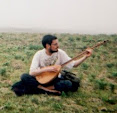
Yig plays a harmonium, Will plays a dholak (Indian double-ended drum) and they both sing. Rupert added extra percussion, and I improvised on my saz.

I particularly like playing with bhajans - they're relatively simple, repetitive, and trance-like, and there are endless possibilities for intuitive melodic and harmonic exploration. I remember playing with a group of Hare Krishnas at Stonehenge, summer solstice 2001. The sonic environment was dominated by clumsy, drunken djembe-bashing, but out on the perimeter, a little enclave of Krishnas was producing this wonderfully clean, precise and ecstatic devotional music, and welcomed me to play along. A couple of years later I was invited along to play at the Exeter Krishna group's diwali celebration at the Friends Meeting House, and a Green Gathering a couple of summers back I found myself playing bhajans with a group of Avalonian types based around a small yurt which had been made into a temple to Radha, Krishna's female consort.


image from http://web.missouri.edu/~omshanti/OmNamahShivaya.html

I'd like to do more of this. Although I don't seem to be able to adhere to any particular belief system, it feels very good for my whole being to play bhajans. I wholeheartedly approve of the whole phenomenon of devotional music and the recognition that music can act as a sort of bridge between the material and immaterial worlds.

It doesn't really feel appropriate to record this stuff, as that would be too much like trying to pin down or capture something which should properly be given away freely as an offering to the source of creation, or to one's higher self. But there may come a time when it feels right to do this, in which case I'll make any such recording available here.

Monday, July 11, 2005

photos from Ireland

This morning some photos arrived in the post from my visit to Kris and Birgit on the west coast of Ireland in the spring.


Christy, Aïcha (Kris and Birgit's daughter), me, Andy Ra, Kris
Kerry mountains in background


Christy (bongos), Kris (mandola) + Andy Ra (didgeridoo), me (saz)
Kris and Birgit's front room, Sneem


Listen Here


me, saz and Jean-Claude (K&B's cat) + me and Andy Ra + Christy looking pensive.

I met Kris, and our good friend Alan, back in 1991 in Gent when they were both studying African History at the University there.


Christy asleep with one of Kris's African history books

Kris played beautiful psychedelic blues guitar, and I would sometimes play a bit of percussion with him. We shared an enthusiasm for US west coast psychedelia, and would listen to Quicksilver Messenger Service and Grateful Dead records up in his student room (as well as reggae, African stuff and even Ice-T!). In '93 or '94 he and Birgit visited Turkey and he came back with a saz, the first I'd seen. I played a bit of guitar at that time, but never really got very far with it, so when I saw a cheap saz on sale at a local tweedehandsbeurs (second-hand market) I leapt at the opportunity, and have hardly touched a guitar since.

Alan didn't last long in academia, instead becoming a devoted scholar of reggae and Rastafarian culture. This influenced us all, and continues to. Not long after I got my saz, he and Kris ended up in a psychedelic dub band based in Sint-Niklaas, called Oort Cloud (this was a name I suggested, an astronomical term named after a Dutch astronomer). I occasionally played a bit of guest percussion with them. The band became the centre of a community of friends which persists today. Funkey, the keyboard player, has been incredibly supportive of my and Inge's music, kindly and skillfully recording some of the best stuff we've done.

Gradually Alan, Kris and Birgit, and some other Belgian friends relocated to the west of Ireland (Kris plays Irish trad. mandola these days!), and the Oort Cloud dissolved. Two or three years ago, though, there was a reunion gig for a New Year's Eve party in Gent. This was a particularly excellent occasion, and Inge and I even got to do our Ail Fionn thing with full psychedelic dub backing after their main set, then jam acoustically with Sven:


me, Inge and Sven playing after Oort Cloud reunion gig, Nieuwjaar 2002 or 2003, Gent

Unfortunately, this didn't get recorded, but I have dug out an old tape of a jam involving me, Inge, Kris, Alan and various Oort-friends, recorded at the Phoenixstraat cite in 1994. It's rough, but spirited, goes on for eighteen minutes and probably catches the spirit of that group of people at that time as well as anything I've got. Kris is playing bass, Fifi (who also played with Oort Cloud) is playing didg.

Listen Here [hi-fi]      Listen Here [lo-fi]

I should hasten to add that this rather rough front-room jam is in vivid contrast to the extremely fine musicianship of the Oort Cloud itself. Hopefully one day some more of their recordings will make it onto the IAA or some other online audio archive.

Sunday, July 10, 2005

Holmbush Festival

Another friendly little festival yesterday - the Holmbush Festival out near Ide on the outskirts of the city. The weather was so perfect that I cycled out and met Simon and Keith there.

This was the first time in ages that the original Drone trio have played together and, appropriately, involved proper old-school 2001-style acoustic instrumentation. We'd been asked to play in the 'acoustic space', a half-bender construction, with a plastic sheet over a hazel frame (see below). We managed to get quite a nice sound together, despite the extreme proximity of the very noisy A30 (rumbling away behind us). Our tiny audience later claimed that our playing appeared to respond to the surges in the traffic sound, which is interesting. Unfortunately, after about ten minutes, the main sound system (not far in front of us) started playing heavy rock music...and then a large aircraft started to pass overhead. I joked that we only needed some seismic rumbling from below to be completely surrounded by disturbing noise. We cheerfuly gave up at that point, and went to enjoy the festival atmosphere.


Keith, me and Simon in the acoustic space

Simon played a brief set as Sufiboy a bit later, during which I provided guest "vocals", reading out the extraordinary list of ingredients from the Co-op "classic cheese and onion sandwich" he had bought from the little shop up the hill (and eaten!) about an hour earlier. I adopted a sort of sombre/disturbed Robert Calvert-type voice (a la "Sonic Attack"), which seemed appropriate, considering the text in question:

"Co-op Classic Cheese & Onion Sandwich

INGREDIENTS (greatest first): White Bread (56%) (wheat Flour, Water, Malted Wheat Flakes, Wheat Bran, Malted Wheat Flour, Yeast, Wheat Protein, Salt, Spirit Vinegar, Emulsifiers (Mono- and diacetyl tartaric acid esters of mon- and diglycerides of fatty acids - Vegetable, Mono- and diglycerides of fatty acids - Vegetable, Sodium stearoyl-2-lacylate - Vegetable), Potassium chloride, Vegetable Oil (Rapeseed, Palm), Flour Treatment Agent (Ascorbic Acid)), Medium Mature Cheddar Cheese (17%)*, Mayonnaise (16%) (Rapeseed Oil, Water, Egg Yolk (Free Range), Spirit Vinegar, White Wine Vinegar, Starch, Dijon Mustard (with Mustard Seeds), Salt, Sugar), Red Leicester Cheese (6%)* (with Colour (Annatto)), Onion (2%)

*Made using a vegetarian rennet derived from a genetically modified micro-organism

Contains Annatto which has been associated with food intolerance.
ALLERGY ADVICE: Contains Egg, Gluten, Milk
CAUTION: Not suitable for people on a low or restricted potassium diet
ORIGIN: Made in UK using EU Cheese and British or South American Onion for Co-op M60 4ES"


Meanwhile, Simon was playing an egg slicer, zither-style, through numerous electronic effects. For his second piece, he wired up a sausage to his 'PlantChant' device to create an ungodly warped-out thrash/techno monstrosity of a sound. This received an almost ecstatic reaction, with two members of the audience immediately rushing up and offering him another mini-festival slot, describing the performance as "the best thing EVER". So we're talking about expanding on the theme of collaborative electronic weirdness plus disturbing ingredient recitals as a neo-dadaist performance concept.

Listen Here


Simon (left) playing the same sausage at a Blender happening a couple of days ealier.

We stuck around for a while and witnessed an encouragingly eclectic range of music. My favourite was a couple of lovely, gentle folk musicians (guitar, voice and fiddle) who played a couple of Irish tunes, a desperately sad Scottish ballad called "Robin Rattle's Bastard" , a slow, lilting version of "Star of the County Down" and a Woody Guthrie song about a train crash.


folkie duo performing at Holmbush Festival

Also on offer was someone calling himself Will Fearless, playing mashed-up dance music via his laptop, another tall young man in shades with two drum-machine or sequencer-type devices awkwardly strapped around his body plus midified (it seemed) guitar, playing covers of obscure 80's Euro-trash disco-pop songs in a kind of post-post-ironic take on the current 80's retro-nonsense, and a punk band (pretty good, although the vocals could have done without the standard anguished American accent) who introduced each song with the tautological proposition "This is our next song.".

*     *     *

This morning I streamed last Sunday's Music Matters off the BBC Radio 3 website to listen carefully to the interview with virtuosic ninety year old pianist Earl Wild wherein he says some interesting things about improvisation and music in general. Here's a partial transcription:


Earl Wild - image from http://shigerukawai.com

[After mentioning that he was recently the head of a group of judges at the Rachmaninoff International Piano Competition in Los Angeles:]

EW: "I'm never going to go to another competition. All the fussing...and it's become a social event, and sometimes it's quite ugly."

Presenter: "You never did competitions yourself then?"

EW: "No. Why? I had to work in orchestras, I had to play for comedians when I first went to New York, and I had to do backgrounds from radio shows and then I moved into television and had to do backgrounds for television and then I learned to play gypsy music through a gypsy I knew, and I played in a gypsy orchestra. I did everything that you could possibly do. Many of the pianists of that time who had rather good names looked down upon me because of that, but in the long run, I feel it was worthwhile."

...

EW: "I had so many teachers in my life, I never stayed with one person very long. The man that I liked the most was Egon Petri, because he could improvise. One day, at a lesson, he improvised for me parts of Die Meistersinger with "Roll Out the Barrel", and it was wonderful! Sometimes I would improvise for him. It was just so congenial that I never thought of it as a lesson.
...

Improvisation is a strange thing. It requires the ear, the brain, and the last thing is the hands. Everybody thinks the hands are so important...It's not that at all. It's the ear and the brain which sends to the hands...tells them what to do. My hands at ninety are very flexible still, because any time anybody started to tell me that I had to tighten up when I played, I left."

Thursday, July 07, 2005

"Come Ye Yourselves Apart"


"Come Ye Yourselves Apart and Rest A While" - incription over entrance to St. Stephens

Another session at St. Stephens church last night: James S (with newly-acquired, and gleefully-employed, effects module), James T, Henry (without his kit, just playing hand percussion), Keith (gone acoustic for the evening), Melski (who arrived for the second half) and I.

It was quite an odd one, felt rather disjointed to me at the time. Perhaps the dark moon had something to do with it. The first half felt like a bit of a struggle (although as I'm listening back to the minidisc right now, it doesn't sound that way), but after our obligatory tea break, the second half felt much more relaxed. I'd somehow managed to accept the relative sense of disunity, and decided to get into it, to try to make it work. While playing, it occured to me what a good metaphor group musical improvisation is for life itself. Sometimes it all just flows along beautifully, but there are going to be times when it's a real struggle, and you just have to try to make the best of it.

We even had an audience, briefly. Three people (one couple, one woman on her own) wandered in off the High Street. I have no idea what they made of it. As some of us were wandering around the church as we played, probing the acoustic, Melski was exploring the percussive possibilities of a cardboard box, and the two James's were experimenting with the sonic possibilities of a bucket of water, it may have come across like a group music therapy session in a mental institution. The inscription "Come Ye Yourselves Apart..." over the door sometimes seems to describe the collective psychic state we achieve in some of our further-out musical moments.

Listen Here

When I got back to Oblique House, I switched on the TV and was pleasantly surprised to find a woman with "interesting hair" playing and talking about Bach's Goldberg Variations on BBC1. Melski arrived shortly thereafter and identified her as Joanna MacGregor. The name rang a bell, and after a few seconds I recalled that I'd heard her extraordinarily radical arrangement of Bach's The Art of Fugue on Radio 3's broadcast from the London Jazz Festival a couple of years ago (with tablas, free jazz improvisation, etc.). Fortunately, I'd recorded that off the radio, sensing from the introductory discussion that something remarkable was about to occur (and I was right). That tape was dug out, and made an excellent accompaniment to this morning's breakfast.


image from http://www.soundcircus.com/interview/biography.htm

Tuesday, July 05, 2005

Central Wisconsin, 2001

Back in the winter of 2000-2001, I was over in central Wisconsin, visiting family. My guitarist friend Peter Fee and I were playing at an open mic session at the since-demolished Witz End just outside Stevens Point, and he suddenly suggested that an "amazing tambourine player" he'd met might be persuaded to join us. Peter disappeared and reappeared fairly soon after with Ryan Biesack who, indeed, had an almost miraculous ability to make a tambourine (one with a skin) sound to my ears like a full drum kit plus tablas!


I got to know Ryan, and discovered that he had been a jazz drummer out on the west coast, had toured India on trains with a modern jazz trio, and then studied South Indian percussion. He's quite easily the best percussionist I have ever had the honour of playing with. Ryan introduced me to Vincent Miresse, a local percussionist (more Latin influenced) and didgeridoo player. Vinnie had travelled in Australia and Cuba, and was also an exceptional player. Over the following couple of months we played together quite a lot as an unnamed improvisational trio - at various local open mics, on the local University radio station WWSP 90FM, and with a local bellydance group at a variety of venues.

Very little of this got recorded, but enough to capture the flavour of what we were doing back then. I've finally got around to cleaning up and editting a tape of our radio appearance and a four-track tape (marred by distortion, etc.) from a set we did with the bellydancers in Shawano.

Ryan, more recently, in Poland   Vincent - painting by Joel Gwidt (www.joelgwidt.com)

Listen Here

Vinnie can also be heard playing on a the recording made at the local yoga studio in the spring of 2002, involving me, a couple of local jazz players, and others:

Listen Here

Monday, July 04, 2005

weekend festivities

A couple of small festivals this past weekend...


On Saturday there was a friendly little event in a field near Coleford. This has been put on annually by a local guitarist and all-round-good-bloke called John Richards. Children of the Drone have played at the last three, which just keep getting better.

The quality of music was generally excellent - folkie stuff, a lively cover band (with John R. guesting on guitar), singer-songwriters, French bagpipe-based dance music, a raucous country/blues band, etc.

The musical highlights for me were (1) local guitar hero Dave Wood's set (in which he played some Renbourn-style crystalline folkiness and then succeeded in turning The Monkees "I'm a Believer" into high art and getting everyone present to sing along with no encouragement whatsoever) and (2) a bunch of relatively young raggle-taggle folkie types with muddy boots, two fiddles, a tea chest bass and a punkrock attitude! They were called "Stack McGraw" or "Stack McDuff" or something (they didn't seem entirely sure themselves when I asked). A proper festival band. Their set included some familiar klezmer tunes and Jolie Holland's "Old Fashioned Morphine" - a wonderful, albeit rather dark, song which I've been listening to a lot lately.


Stack McSomething play on the back of a flatbed truck

"Sister don't get worried, sister don't get worried, sister don't get worried, 'cos this world is almost done..."

Pulse played two sets, intended as dance music. This time it was Richard, Henry, Keith, Mark, Rupert and me. Unfortunately the first set was a bit too early on, and people were quite happily spread out on blankets - greatly enjoyable, though. By the time we'd got on to do the second set, most people had gone, or had converged on the bonfire to keep warm (a chilly July evening, typical English weather).

When I got home, I watched parts of the Live 8 concert from Hyde Park, including the reunited (and frankly magnificent) Pink Floyd. I've never been that interested in their post '73 output, having perhaps been a bit of an obscurist Floyd snob, content to listen to hissy bootleg tapes of Syd Barrett-era outtakes. It's only relatively recently that I've come to admit that Dark Side of the Moon is actually a rather impressive piece of work! But I was curious to see what it would be like for the post-Barrett line-up to be on stage together again, so I plugged my headphones into the TV, turned the volume right up, sat back...and was thoroughly blown away. I never expected them to play "Set the Controls for the Heart of the Sun" or "Vegetable Man". That would have been entirely inappropriate in the circumstances. But even though they played songs which never meant a huge amount to me, there was something really moving about it.

The Floyd somehow embody a certain aspect of the collective western post-1965 psyche, having gone through the phases of naive psychedelic whimsy ("See Emily Play"), deep psychedelic exploration (Ummagumma), Syd's psychosis, profound cynicism (Wish You Were Here), nihilism (The Wall) and a gradual transmutation into a corporate machine (the post-Waters era). The anger and bitterness which led to Roger Waters' departure therefore carried more weight that just a feud between a couple of individuals - the fracture went deeper than that, had wider resonances in the psyches of that huge constituency to whom the band meant so much. So to see Waters and Gilmour on stage together twenty-four years later, playing magnificent, powerful music, and even half-embracing at the end, felt like some kind of collective healing emanating out into the world. Something broken had been made whole again, and it had happened because a cause bigger than any individual (the pursuit of justice in the West's dealings with Africa) had allowed these people to temporarily transcend their individual egos and do the right thing.


image from http://www.brooklynvegan.com/

There was a huge sense of elation being felt around the planet, as the result of four blokes getting on a stage and playing four songs. This may seem slightly absurd, but one only has to compare the 'cult' of Pink Floyd (or The Beatles or U2) to, say, the cults associated with medaevil saints to start to get the picture. The global Pink Floyd 'cult' is enormous, and even if it would be rather difficult to say what it was 'about', this is not really the point. What were the cults of St. Bartholomew or St. Anne 'about'? They carried a certain 'vibe' which is as inaccessible to most of us today as Pink Floyd would be to your average medaevil Christian. This to me seemed to be the power of the whole Live8 event. These 'big name bands' have, for better or worse, become projection screens for the religious instincts of a large sector of the secular western populus. Hence, by bringing them all together, creating a sense of quasi-religious awe in a huge audience, carefully interspersed messages about the global political system, economics, trade, etc. are able to penetrate deeper into the minds of the apolitical fans than would ever be possible through conventional means of spreading messages. It's the same strategy used by corporations who pay vast sums for advertising during major sporting events (which also generate quasi-religious feelings within their audiences), but being employed by people with somewhat nobler motives!

There was something quite thrilling about watching The Who making a huge, visceral electric noise, with Daltrey howling "We Won't Get Fooled Again" while sinister grainy images of the world's suppposed 'leaders' were flashed on the gargantuan screen behind them, and knowing that hundreds of millions of eyes were locked into the event. "This has never happened before," I kept reminding myself. Even when he was singing "Who are you-oo, you-oo" (a bit of a daft song, really), there was a sense that he was addressing these 'leaders' on 'our' behalf: "Who are you? What do you represent? Who do you work for? Who the hell do you think you are?".

It occured to me (and no doubt quite a few other people) that the name "G8" is extremely appropriate, given the increasingly familiar use of "G" as an abbreviation for "gangster" (due to the globalisation of Afro-American slang and hip-hop culture). Also, given the tendency for MC's and hiphop crews to adopt names like "D12", "J5", "KRS-1", etc., "G8" sounds like the name of an 8-man crew of 'gangsta' rappers. The funny thing is, a lot of these crooks and war criminals (Bush, Blair, Berlusconi and Putin come to mind immediately) could more accurately be describe as 'gangsters' than any of the members of 50 Cent's 'G-Unit' crew.

[added later] In the interests of balance, here are a couple of somewhat more skeptical/cynical views on the MPH campaign and Live8 events:

J. Pilger, "From Iraq to the G8"
Adbusters open letter to Bob Geldof

* * *

The next day, Keith, Henry and I played a brief set for the Respect Festival at the Phoenix to a somewhat smaller audience than that to which the Floyd had played the previous evening!

We were playing in a marquee set up outside, and this was probably the first gig we've done at the Phoenix where we weren't competing sonically with a banging techno sound system or a bar full of noisy people. Typically, though, most people had drifted away after Seize the Day finished and before we started, but we had a small but enthusiastic audience, even some dancing.

This was originally going to be a 'Pulse' session, but as Richard couldn't make it, we sort of compromised and turned into a sort of uncharacteristically upbeat, danceable Drone session.

Dronings are usually entirely unpremeditated, but due to these unusual circumstances we bent the rules, and so the third piece was a jam built around a bassline inspired by the incomparable Jamaican guitarist Ernest Ranglin's classic "Surfin'"


photo by Jane Jarvis of http://www.efestivals.co.uk

Listen Here

Another highlight of the weekend was discovering that Children of the Drone have received their first proper review, and an extremely encouraging one at that!